
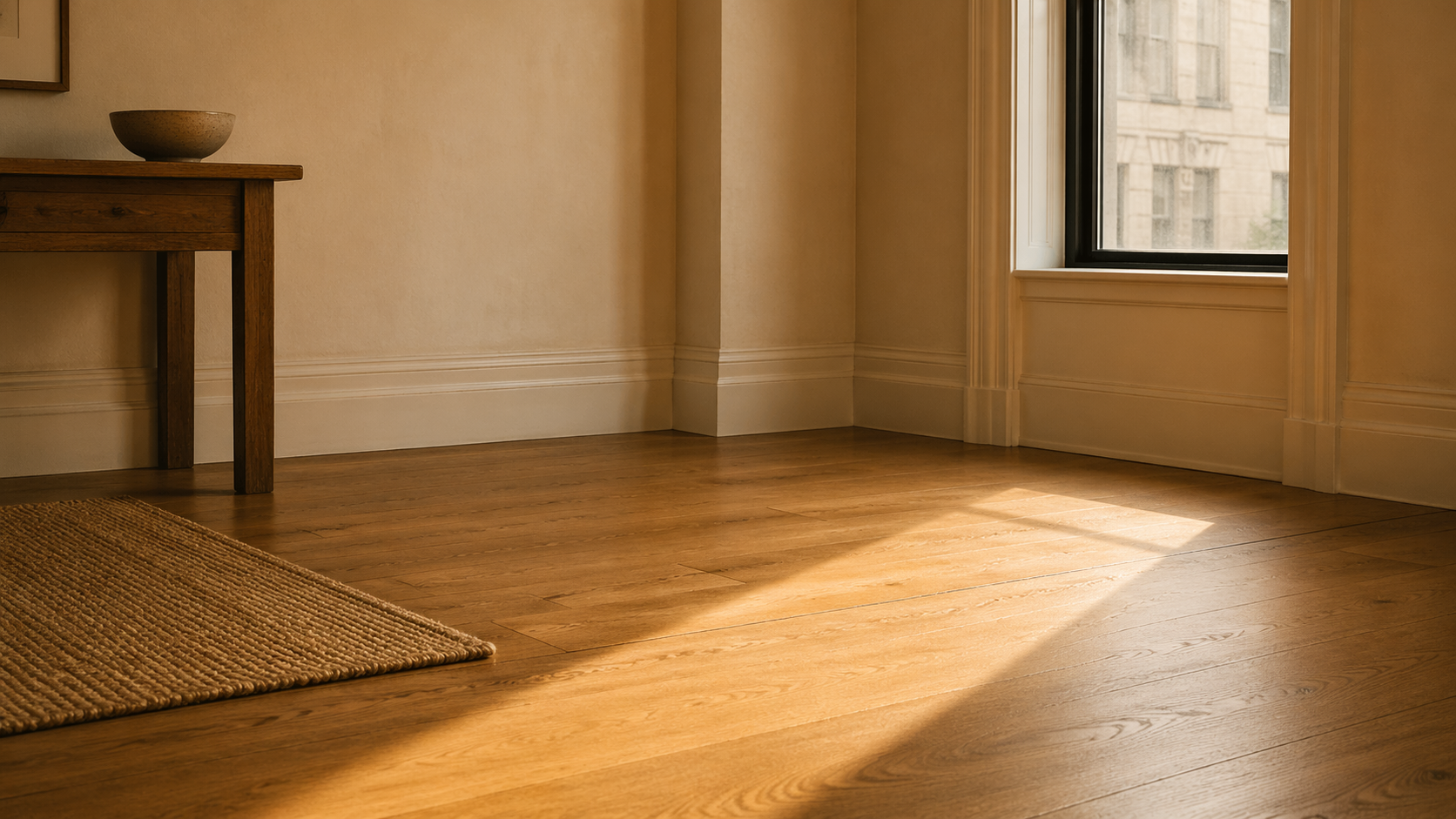
Your Prewar Oak Floors Want Less Than You Think
The oak floor under your bare feet on a January morning feels tight and dry. Run a fingernail along the seam between two strips - a gap opens to the width of a credit card edge. The wood is not broken. It is breathing.
At 7:30 on a January morning in a prewar one-bedroom off Riverside Drive, the radiator ticks and the oak floor under your bare feet feels tight and dry. Run a fingernail along the seam between two strips. In July that gap was invisible. In January it opens to the width of a credit card edge. The wood is not broken. It is breathing.
Strip oak in prewar Manhattan buildings dates to 1905 through 1935. White oak runs under the parlor floors of Upper West Side classic sixes and Park Slope brownstones. Red oak shows up in Morningside Heights walk-ups and stretches of the Upper East Side. The boards measure 2.25 inches wide and sit on a pine subfloor with tongue-and-groove joinery and no expansion gap at the wall. A century of sanding and refinishing has left most of them between 5/8 and 3/4 of an inch thick. The last coat of polyurethane, water-based or oil, sits between 4 and 6 mils deep. That finish is the thing between the wood and the mop water. Care routines that break the finish break the floor.
The Wet Mop Problem
Three products show up on NYC hardware store shelves and land on floors that cannot take them.
Murphy's Oil Soap. Plant-based, gentle, pH around 10. It leaves a thin waxy film on polyurethane that dulls the sheen and holds dust. Two years of Murphy's turns a satin floor cloudy. The fix is a full sand and refinish, which runs $4 to $8 per square foot across most of Manhattan and requires a week out of the space.
White vinegar diluted in water. The acidity sits near pH 2.4. On sealed oak, vinegar softens the top layer of polyurethane and leaves a dull scrim. On worn patches near the kitchen threshold or under a dining chair, it reaches the wood itself and raises the grain.
Steam mops. The steam leaves the pad at 212 degrees and forces vapor into the seams between boards. Prewar tongue-and-groove joints cannot handle it. The tongues swell, the boards cup, and cupping does not reverse. A Shark or Bissell steam mop ruins a 100-year-old floor in a single afternoon.
The Swiffer WetJet is a quieter version of the same problem. The solution is a surfactant blend that leaves a residue. Look for it in raking morning light through a prewar window and you will see it as a faint rainbow film.
What Works
Bona Hardwood Floor Cleaner, the one in the refillable spray bottle, holds a pH of 7.0. It is water-based, leaves no film, and dries in under 60 seconds on sealed oak. Spray a light mist on the floor, not on the mop pad, and pull a damp microfiber flat mop with the grain in overlapping passes. Work in sections of 40 to 50 square feet. The pad should feel cool and damp to the back of the hand, not wet. If the floor stays wet for more than 30 seconds after a pass, the pad is too saturated. Wring it out.
For daily or twice-weekly pickup, use an untreated microfiber dust mop. Skip the Swiffer Sweeper dry cloths. The treatment on those cloths leaves a tacky residue that attracts dust faster than it removes it. A plain microfiber head rinses out in the sink and lasts a year.
Vacuum with the hard-floor setting engaged. A beater bar on oak scratches the finish in thin parallel lines. You will see them the first time the afternoon sun comes through a south-facing window.
The Humidity Problem
Steam heat in prewar buildings pushes relative humidity below 20 percent from November through March. White oak holds its shape between 30 and 50 percent RH. Below 20 the boards shrink and the seams open. Above 60 they swell and cup. The credit-card gap in January is the wood losing moisture to the radiator.
A $15 hygrometer from Amazon or a hardware store on Amsterdam Avenue tells you the actual number in your living room. If it sits under 30, run a cool-mist humidifier in the main room overnight. Forty percent is the target. The seams you noticed in January will close on their own by May once the building heat shuts off and ambient humidity rises.
One other note. Rubber-backed rugs and felt pads with adhesive glue can yellow a polyurethane finish in a rectangle the shape of the pad. The discoloration does not come out. Use natural rubber pads or jute pads instead, and lift the rug twice a year to let the floor breathe.
Between the Mopping
Shoes come off at the door. Manhattan sidewalk grit is a mix of road salt, soot, and glass dust, and it scratches oak finish faster than any mop head does.
Felt pads under every chair leg and table foot. Replace them every three to six months. A dining chair with a worn pad carves a half-moon into the finish in front of the table within a season.
An entry rug at the door catches the first ten steps of grit. A runner down a long Brooklyn Heights hallway saves the middle of the floor from the highest-traffic path. Use a rug pad that lists natural rubber or felt on the label. Avoid vinyl and latex.
Check your work under raking light. Stand at one end of the room with a window behind you and look across the floor toward the opposite wall. Streaks, residue, and missed spots show up in the low angle that ceiling lights hide. Prewar windows are tall and low-silled, which makes this easier than it sounds.
The pH Problem in Your NYC Bathroom
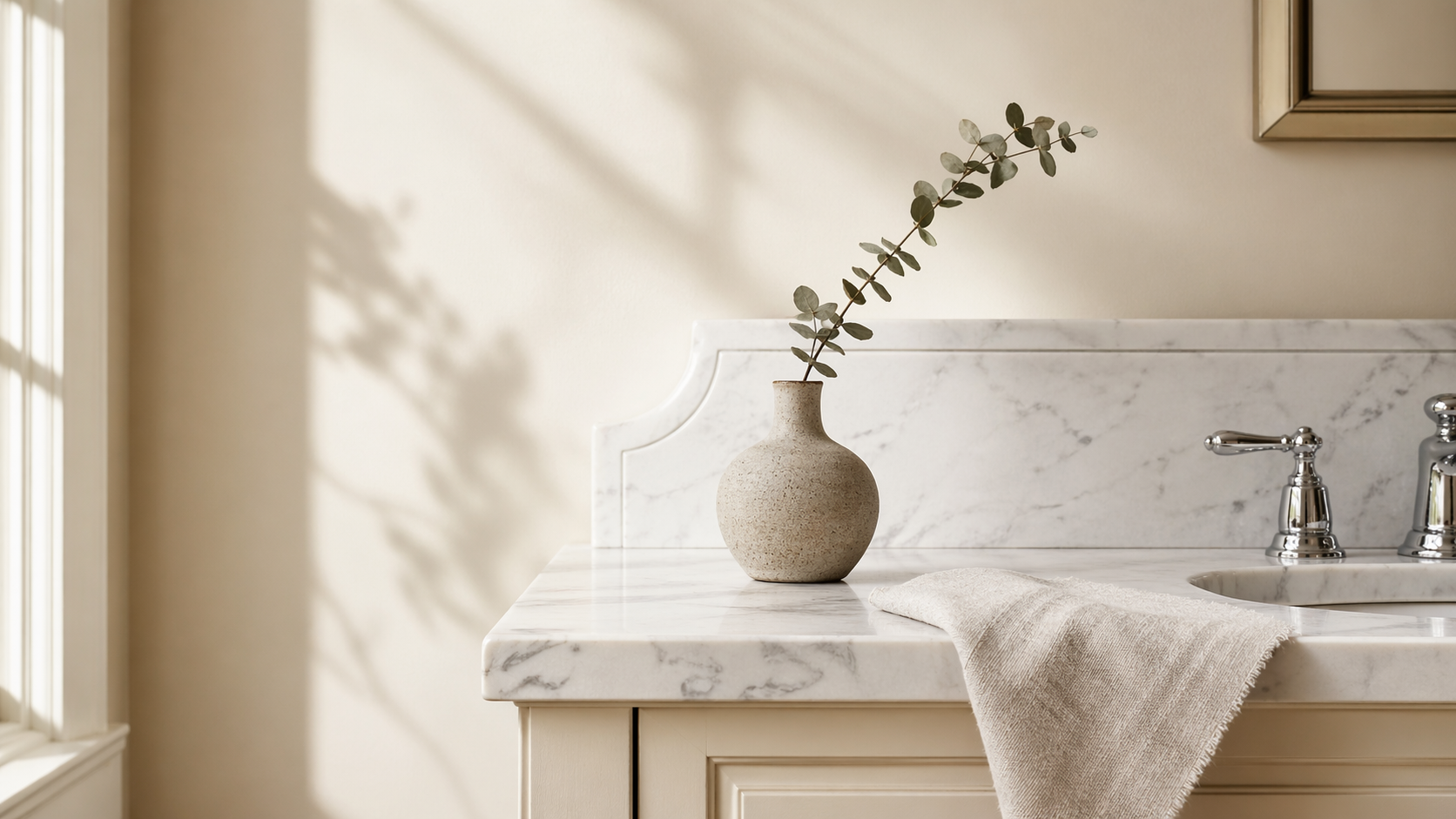
The grout between your Carrara hex tiles is turning yellow. The marble vanity has a dull ring where a coffee mug sat last week. You are not imagining it - your bathroom is aging faster than the rest of your space, and the products under your sink are likely why.
The grout between your Carrara hex tiles is turning yellow. You noticed it Tuesday morning, barefoot on the bath mat, waiting for the shower to warm up. The marble vanity has a dull ring where you set your coffee mug last week. And something is happening to the chrome fixtures that no amount of wiping seems to fix.
You are not imagining it. Your bathroom is aging faster than the rest of your space, and the products under your sink are likely accelerating the damage.
Thirty Seconds of Vinegar, Five Hundred Dollars of Regret
Most cleaning advice on the internet will tell you to spray vinegar on everything. Vinegar is a 2.5 on the pH scale, roughly as acidic as lemon juice. Marble, limestone, and travertine are calcium carbonate. When acid meets calcium carbonate, it dissolves the surface. This is not gradual wear. A single drop of undiluted vinegar etches polished marble in 30 seconds. You can feel the difference with your fingertip: a rough, cloudy spot where the stone was smooth.
Professional marble resurfacing in Manhattan runs $3 to $8 per square foot. For a standard NYC bathroom vanity top, that is $150 to $400. For a full marble-walled shower, $500 to $1,200. The vinegar you used to save money just created a bill that dwarfs a year of proper cleaning products.
The rule is simple. Anything below pH 7 should never touch natural stone. This eliminates vinegar, lemon, most all-purpose sprays (Method, Mrs. Meyer's, and Seventh Generation all-purpose cleaners range from pH 3 to 5), and any product labeled "cuts grease." If the bottle does not list its pH, assume the worst.
What Actually Works on Stone
StoneTech Professional Stone and Tile Cleaner is the standard. It sits at pH 7 to 8, costs about $12 for a 24-ounce concentrate, and is the product that professional stone restoration crews in NYC use between resurfacing jobs. Dilute 2 ounces per gallon of warm water. Spray onto a microfiber cloth, not the surface. Wipe in straight, overlapping passes. Buff dry with a second cloth.
For daily maintenance, plain warm water and a microfiber cloth handle 90% of what a marble vanity needs. The vanity top collects toothpaste, soap residue, and hard water spots. Warm water dissolves all three without risking the finish. Wipe once in the morning when you notice the mess. Ten seconds. The cumulative effect of daily wiping outperforms a weekly deep scrub every time.
Reseal your marble every 12 to 18 months. StoneTech BulletProof Sealer is the professional choice for high-moisture environments like bathrooms. You can test whether your stone needs resealing: place a few drops of water on the surface and wait 10 minutes. If the stone darkens underneath, the seal has worn through.
The Hard Water Layer You Cannot See
New York City water comes from the Catskill and Delaware watersheds. It is softer than most American cities, averaging 1.5 grains per gallon compared to 10 or higher in places like Phoenix or Indianapolis. But soft is not zero. Calcium and magnesium still deposit on every surface the water touches, building a mineral film that dulls chrome, clouds glass, and makes tile feel gritty underfoot.
The deposits are alkaline, sitting around pH 8 to 9. An acidic cleaner would dissolve them, but you cannot use acid on marble. This is the specific problem NYC bathrooms present: alkaline buildup on acid-sensitive surfaces.
The solution is mechanical, not chemical. A damp microfiber cloth with tight 200 GSM weave physically lifts mineral deposits without altering surface chemistry. For shower glass, use a dedicated glass cloth (waffle-weave microfiber works best) dampened with distilled water. Tap water deposits the same minerals you just removed. One drop of a plant-based concentrate like Branch Basics in 24 ounces of distilled water creates a streak-free glass cleaner that costs under a penny per use.
Squeegee the shower glass after every use. This is the single highest-return habit in bathroom maintenance. Sixty seconds of squeegeeing prevents the mineral buildup that takes 20 minutes to scrub off later. The OXO Good Grips Wiper Blade Squeegee ($10, stainless steel, suction-cup mount) hangs in the shower and disappears against tile.
Disinfecting Without the Chemical Trade-Off
Toilets and high-touch surfaces need disinfection, not just cleaning. These are different operations. Cleaning removes visible soil. Disinfecting kills pathogens. Most conventional disinfectants (Lysol, Clorox) contain quaternary ammonium compounds or sodium hypochlorite. They work. They also leave chemical residue on every surface they touch, off-gas volatile organic compounds into a small, poorly ventilated NYC bathroom, and require you to open a window in a room that may not have one.
Force of Nature is an electrolyzed water system that converts salt, water, and a small amount of vinegar into hypochlorous acid, the same molecule your white blood cells produce to fight infection. It carries EPA hospital-grade registration, meaning it kills 99.9% of MRSA, Norovirus, Influenza A, and Salmonella. It leaves no residue, produces no fumes, and breaks down into salt water.
The catch: it requires a 10-minute dwell time on toilet surfaces to achieve full disinfection. You cannot spray and wipe. Spray the bowl interior, close the lid, and walk away. Come back in 10 minutes. This is not a suggestion. The EPA registration is based on that contact time. Cut it short and you have expensive water.
Each capsule makes roughly a gallon of solution and costs about $0.65 on subscription. A gallon covers 4 to 6 bathroom cleanings. The activated solution has a 14-day shelf life, so make a fresh batch every two weeks.
The Grout Problem
Grout is porous. In a bathroom, it absorbs moisture, soap residue, body oils, and mildew spores. The yellowing you see is not surface dirt. It is discoloration that has penetrated the top layer of the grout.
For maintenance cleaning, Branch Basics All-Purpose dilution (one part concentrate to eleven parts warm water) on a stiff-bristle brush works on most grout stains. Apply the solution, let it sit for 60 seconds, scrub in short strokes along the grout line (not across the tile), and wipe clean. Warm water activates plant-based surfactants faster and increases cleaning power by roughly 20%.
For stubborn discoloration, make a paste of Branch Basics Oxygen Boost and warm water. Apply to the grout lines, cover with a damp cloth, and let it sit for 30 minutes. The oxygen-based bleach lifts stains without the fumes or surface damage of chlorine bleach. Rinse until the water runs clear. One $10 container of Oxygen Boost handles about 30 grout treatments.
Seal your grout after deep cleaning. Unsealed grout reabsorbs everything within weeks. StoneTech Heavy Duty Grout Sealer applied with a small foam brush takes about 20 minutes for a standard bathroom. Reseal annually.
If the grout has turned black and no amount of scrubbing changes it, the mildew has penetrated too deep for topical treatment. A professional regrout of a standard NYC bathroom shower runs $400 to $800, and most tile contractors in the city are booked 3 to 6 weeks out. Squeegeeing, ventilating, and sealing cost less than a contractor. Do all three.
Ventilation in a City That Forgot About Windows
Most NYC bathroom exhaust fans move 50 CFM (cubic feet per minute) of air. Building code requires 50 CFM for intermittent ventilation or 20 CFM for continuous. In a 40-square-foot bathroom with 8-foot ceilings, that is 320 cubic feet of air. A 50 CFM fan needs roughly 7 minutes to exchange the air once.
Run the fan for 20 minutes after every shower. Not during. After. The humidity peak occurs 5 to 10 minutes after you turn off the water, as steam continues rising from wet surfaces. Turning off the fan when you leave the bathroom traps moisture at its highest concentration.
If your bathroom has no fan and no operable window (common in prewar conversions across the Upper West Side, Morningside Heights, and parts of Brooklyn Heights), a small USB-powered circulating fan on the vanity moves enough air to reduce surface moisture. Position it to blow toward the bathroom door, pushing humid air into the larger apartment where it dissipates. This is not ideal. It is the realistic option for a 1920s building where the bathroom was carved out of a hallway closet.
Persistent mildew in a bathroom with a functioning fan points to a clogged or disconnected duct. In buildings built before 1960, ductwork sometimes terminates inside the wall cavity rather than venting outside. Ask your super to verify the duct path. This is a building maintenance issue, not a cleaning problem.
A Weekend Routine That Takes Eight Minutes
Saturday morning. Before coffee leaves a ring on the vanity.
Wipe the vanity top and sink with a damp microfiber cloth. Thirty seconds. Spray Force of Nature inside the toilet bowl, close the lid. Wipe the mirror with a dry waffle-weave cloth. Spray the shower walls with Branch Basics Bathroom dilution (one part concentrate to five parts warm water) and let it sit. Wipe the faucets and fixtures dry with a clean cloth.
Come back in 10 minutes. Wipe down the shower walls. Scrub the toilet bowl, flush, wipe the exterior. Mop the floor with a damp microfiber pad. Exit backward so you do not walk on the wet floor.
Total active time: 8 minutes, split into two passes. The products do the work during the gap. You drink your coffee.
What White Glove Actually Means Inside a New York Apartment
Five cleaning services in Manhattan use "white glove" in their business name. None of them publish a definition. The phrase floats through Yelp bios and Google ads without a single concrete claim attached to it. The term has a real meaning, though - and you can see it in the details.
Five cleaning services in Manhattan put "white glove" in their business name. None of them publish a definition. The phrase floats through Yelp bios and Google ads without a single concrete claim attached to it. It sounds like a promise. It functions as decoration.
The term has a real meaning, though, and you can see it in the details of how someone maintains a space. Not in the marketing language. In the bottles under the sink, the cloths in the caddy, the order someone cleans a bathroom, and whether the person doing the work knows the difference between your marble and your quartz. Below is what the phrase looks like when someone means it.
The Product Test
A Carrara marble island in a Flatiron condo costs between $90 and $180 per square foot installed. White vinegar etches it in under 30 seconds. Lemon juice does the same. Most all-purpose sprays on a Duane Reade shelf hold a pH between 2 and 4, acidic enough to dull the polish on first contact. The damage shows up the next morning as a cloudy ring in direct sunlight.
Real surface care starts from the material, not the stain. Marble and limestone need a pH-neutral stone cleaner in the 8 to 9 range. Sealed hardwood takes a dedicated floor product at pH 7.0 and nothing else. Stainless steel requires wiping with the grain, which usually runs horizontal, and an immediate dry buff to prevent haze. Glass needs its own formula: one drop of plant-based concentrate in 24 ounces of distilled water. Tap water leaves mineral spots.
Six products cover ninety percent of surfaces in a 1,400-square-foot Upper West Side two-bedroom. The question to ask any cleaning service is not "what products do you use" but "what do you put on marble, and what do you put on the oak floor, and are they different bottles?" If the answer is one spray for everything, the $9,000 counter is at risk.
The Color Code
Cross-contamination is the invisible failure mode in apartment cleaning. A cloth that touches a toilet seat and then wipes a kitchen counter transfers bacteria between the two surfaces. Most people cleaning their own spaces do this without thinking. Most services do it too.
The fix is a color-coded microfiber system. Blue cloths touch glass and mirrors only. Green handles kitchen surfaces and living area dusting. Yellow stays in the bathroom, with one cloth marked for the toilet and nothing else. Red covers floors. Four colors, four zones, zero overlap.
Fold each cloth into quarters for eight clean panels, four per side. When one section picks up grime, you refold to a fresh panel instead of pushing dirt across the surface. A single cloth covers 400 to 500 square feet before it needs swapping. At that point the fibers are saturated and the cloth drags instead of absorbing.
You can set this system up at home for under $70. A 50-pack of professional-grade 16-by-16-inch microfiber cloths costs about $1.70 per cloth from a wholesale supplier. Order them in four colors. Wash in hot water at 140 degrees with fragrance-free detergent. Skip the fabric softener. It coats the microfiber strands and kills their absorbency for good.
The Sequence
A master bathroom in a Chelsea one-bedroom runs between 35 and 48 square feet. Cleaning it in the wrong order doubles the time and halves the result.
The common approach starts with the toilet, moves to the counter, finishes with the floor. The problem: toilet aerosols land on the counter you just cleared. Counter runoff hits the floor you are about to mop. The mop picks up both.
The right sequence starts at the ceiling and ends at the drain. Spray the toilet bowl first with an electrolyzed-water disinfectant, close the lid, and walk away. That starts a ten-minute dwell timer. Spray the shower surfaces with a pH-neutral soap scum remover and let those sit too. Now clean the mirror while it is dry and streaks are visible. Wipe the counter and sink. Return to the shower after three to five minutes of dwell. Scrub, rinse, squeegee the glass door. Return to the toilet after ten full minutes. Scrub the bowl, flush, wipe the exterior with the dedicated toilet cloth. Mop the floor last, backing out through the doorway so you leave no footprints on the wet tile.
Forty-two minutes for one bathroom. Most quick-turnover services finish in fifteen. The difference is the dwell time. A disinfectant sprayed and wiped in thirty seconds never reaches the kill threshold printed on its own label. Ten minutes of contact is what the EPA registration requires. Anything less is theater.
The Order of the Whole Space
Beyond the bathroom, the full sequence matters just as much. Dry tasks come before wet tasks across every room. Dust the surfaces, make the beds, straighten the cushions, vacuum the carpets. Then move to wet work: scrubbing, wiping, mopping. Dry before wet prevents grit from turning into mud under a damp cloth.
Within each room, the direction runs top to bottom, left to right, back to front. Start with the room farthest from the entrance. Work toward the door. Spray the cloth first, not the surface. Wipe in straight overlapping passes, never in circles. Circular motions push grime in loops instead of lifting it.
Stand at one end of a room in a prewar building with a tall window behind you. Look across the floor toward the opposite wall. Streaks, residue, and missed spots show up in that raking low-angle light the way ceiling fixtures never reveal them. The final check takes five seconds and catches what forty minutes of work sometimes misses.
What to Ask, What to Watch
You now know enough to evaluate any service that calls itself white glove. Ask five questions.
What product touches the marble? If they cannot name a pH-neutral stone-specific cleaner, they are using all-purpose spray on a surface that etches.
How do you prevent cross-contamination between the bathroom and the kitchen? If they do not mention separate cloths by zone, the system is not in place.
What is your dwell time on disinfection? If the answer is less than ten minutes on a toilet, the disinfectant is not doing its job.
Do you clean dry before wet? If they mop first and dust second, debris ends up sealed under the wet pass.
How do you verify the work before you leave? Look for a final walkthrough, a raking-light check, or exit photos. Any of those signals a standard above the average.
These same five questions work as a self-audit if you clean your own space. The principles do not change with who holds the cloth. Surface-specific products, isolated zones, dwell time, dry-before-wet sequencing, and a final inspection under natural light. That is the full definition of the term, stripped of its marketing.
Some people find the discipline of this routine satisfying on a Saturday morning. Others would rather hand it to someone who follows it fifty times a month. Both positions make sense.